In October, I was fortunate enough to attend and speak on a panel for the NJSBA Mid-Year Meeting in Portugal. After the conference, we went to Porto for two days. I have been to Lisbon before, but this was my first time in Porto. If you think Lisbon is hilly, wait until Porto! Quite the workout.
Porto is famous, of course, for its port wine lodges, which are actually not located in Porto, but across the Douro River in Vila Nova de Gaia (often called just “Gaia”). Historically, grapes grown in the Douro Valley were transported on boats called rabelos to the port lodges in Gaia, which is on the southern side of the Douro and slightly cooler than Porto. There are 60 port lodges located in Gaia, but only about 20 of them are open for tastings or tours.
Many of the port lodges bear British names, such as Taylor, Graham, Cockburn, Croft, Dow, Warre, and Sandeman. This is because the entire port industry was founded and financed by British merchants. During the 1600s and 1700s, Britain and France were often at war. Every time they were, the British government would ban or heavily tax French wine. British merchants looked to import wines from elsewhere, including Portugal.
In 1703, Britain and Portugal signed the Methuen Treaty, with Portugal agreeing to give British wool textiles preferential treatment, and in return, Britain slashed taxes on Portuguese wines. British merchants swarmed Porto and built warehouses in Gaia, so that they could buy grapes from the Douro Valley farmers, age the wine in their own warehouses, and ship them overseas. To prevent the wine from spoiling in the hot hold of a ship during transport, they began fortifying the barrel of fermented wine with a bottle of grape brandy. The winemakers soon discovered that adding the brandy during the fermentation, rather than after, stopped the fermentation, leaving residual sugar. The rich, slightly sweet, high alcohol wine became a sensation back in Britain.
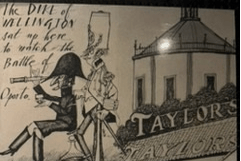
We did a tour and tasting at Taylor Fladgate Port Cellars, established in 1692, and still family-owned. In 1744, the family purchased land in the Douro Valley, which was briefly used as a hospital by the Duke of Wellington during the peninsular campaigns of the Napoleonic Wars. Taylor’s survived the French army’s invasion by transferring 1/6 ownership into an American employee, Joseph Camo, and leaving him in charge while the rest of the owners retreated to Britain, and he managed to keep the enterprise going until the British returned.
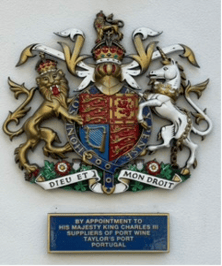
After passing the seal hanging to the left of the door indicating that Taylor Fladgate is “By appointment to his Majesty King Charles III, Suppliers of Port Wine, Taylor’s Port, Portugal,” the tour begins in a museum, laying out the history of Port wine and of Taylor Fladgate, before moving on to the cellars, and how port wine is made. The tour finished in a rose garden, with resident peacocks and hens milling about. We tasted three ports: Chip Dry White Port, a 10 year old Tawny, and a Late Bottle Vintage.
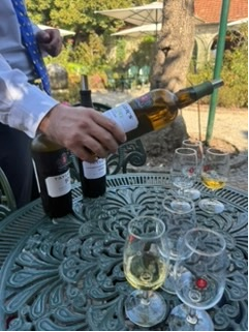
White Port was a discovery for me on this early fall trip to Portugal, with temperatures still reaching the 80s (the last time I was in Lisbon, it was February), with many sidewalk cafés and rooftop bars still open, serving Porto Tonicos in place of gin and tonics. Porto Tonicos are a refreshingly light summer cocktail, swapping out gin for white Port: 2 ounces of Chip Dry White Port, 4 ounces of high-quality tonic water, garnished with a sprig of mint and a slice of orange, lemon or lime, served over ice cubes in a large wine glass. Chip Dry White Port was created by Taylor Fladgate in 1934, using white grapes (primarily Malvasia Fina), and the brandy is added after fermentation, creating a fortified, dry white wine. Chip Dry is 19.5% ABV, and available at Total Wines & More in Cherry Hill for $26.
The second port sampled was a 10 Year Old Tawny Port, meaning that the Port has been aged an average of 10 years. Tawny ports and Ruby (red) ports are made the same way; Tawny Ports are aged for a much longer time (10, 20, 30, even 40 years) in small oak casks called pipas (pipes). More of the wine is exposed to wood, undergoing controlled oxidation, losing its red color while it ages, and fading to a tawny (golden-brown) color. A Tawny port tastes nutty, with dried fruits, and notes of butterscotch and toffee. Since Tawny ports have already been oxidized, they are very stable, and an open bottle can still taste good 2-3 months after opening. Taylor Fladgate’s 10 year old Tawny is 20% ABV, and available at Total Wine & More for $34.
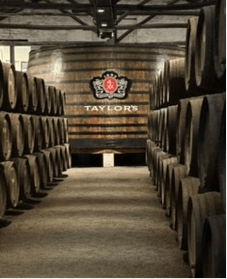
The final port we sampled was a Late Bottle Vintage (“LBV”) Ruby Port. LBV ports are the step between everyday inexpensive ports and Vintage ports. Like Vintage ports, LBV ports are all made from one vintage. Rather than aging in wood for 2 years and then in bottles for many more years like Vintage ports, LBV ports are aged in large wood vats for 4-6 years before being bottled. Upon bottling, they are ready to drink right away. LBV ports typically have dark berry flavors such as blackberry, black currants, and plums, followed by fig, dark chocolate, herbs, and spices. The tannins are softer than a young Vintage port. Once opened, an LBV port will stay good for 2-3 weeks. Taylor Fladgate’s Late Bottled Vintage Port is 19.5% ABV, and available at Total Wine & more for $26.
Saúde!


Leave a Reply