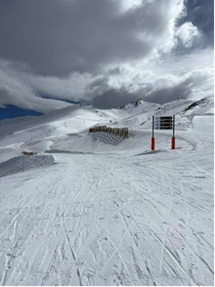
This August, I happily checked another item off my bucket list: skiing in the Southern Hemisphere. I joined the Eastern PA Ski Council on their trip to Chile. One week was spent at Valle Nevado Ski Resort in the Andes, and the second week was split between four nights in Santiago, with days trips to wineries in the Maipo Valley and Casablanca Valley, and three nights in Valparaiso/Viña del Mar.
Although Spanish Conquistadors first planted Vitis vinifera vines in the 16th Century, Chile’s wine industry didn’t really take off until the mid-1990s. In 1995, there were 12 wineries in Chile. A mere ten years later, there were 70 wineries. Protected by the Andes on the East, the Pacific Ocean on the West, the Atacama Desert in the North, and Antarctica in the South, the vines planted in Chile by European immigrants remain completely free of Phylloxera, which ravaged Europe’s vineyards during the second half of the Nineteenth Century. In 2025, Chile was the fifth largest exporter in of wine, trailing behind France, Italy, Spain, and Australia.
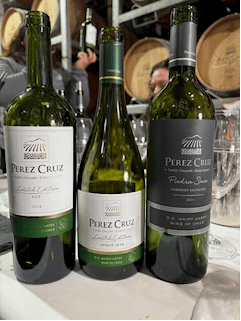
The Maipo Valley, a subregion of Chile’s Central Valley located 45 minutes South of Santiago, is renowned for its Cabernet Sauvignon. We started the day with at Viña Perez Cruz, a sustainable-certified, family-owned winery which released its first vintage in 2002, which I thought was the best of the three we visited. Their wine barrel-shaped winery was designed by (now) award-winning José Cruz Ovalle. Their flagship red is a single vineyard Cabernet Sauvignon called Pircas, made from their best grapes; one step down is their Piedra Seca (“dry stone”).
We tasted the Piedra Seca, alongside their Limited Edition Cot (a.k.a. Malbec) and Limited Edition Syrah. I really enjoyed the Cot for its bright, berry flavors, but the Cabernet Sauvignon was truly exceptional. The 2024 release is 92% Cabernet Sauvignon, 5% Petit Verdot, and 3% Cabernet Franc. The wine is aged for 14 months in 1-3-year-old French oak barrels. Aromas of cherry, blackberry, eucalyptus, and pepper on the nose, medium-bodied and well-balanced on the palate, with fresh acidity, structured tannins, and a peppery and herbal finish. 14.5% ABV; $25 (I could only find it online at Dr. D’s, although Wineworks does carry their Cabernet Franc).
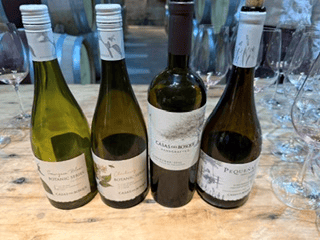
The Casablanca Valley lies one hour west of Santiago. Known for its cooler-climate wines (Sauvignon Blanc, Chardonnay, Pinot Noir, and Syrah), the Valley receives the morning fog and cooling breezes of the Pacific Ocean, powered by the Humboldt Current. We visited Viña Casas del Bosque, another sustainably-certified, family-owned winery, founded in 1993. After a tour, we tasted four wines: Botanic Series Sauvignon Blanc, Botanic Series Chardonnay, Handcrafted Carménère (grapes grown in Cachapoal Valley), and Small Parcels Syrah.
Although all were delightful, their Botanic Series Chardonnay was a lovely Burgundian- style white. Aged in concrete eggs, with restrained malolactic fermentation, it had a rounded mouth feel, but wasn’t too buttery. Aromas of apricot, peach, and apple on the nose, were joined by citrus minerality on the palate. 13% ABV; runs around $15 (I could only find it available online, although the PA stores carry some of their wines at a great price).
If you are looking to drink more Chilean wine that you can get locally, look for Montes, Concha y Toro, and Cousina Macul. ¡Salud!


Leave a Reply