In January, my American Wine Society Chapter met at the home our Chapter President in Columbus, NJ, for a blind tasting of Chardonnays from around the world. Chardonnay is the most planted grape, world-wide. It’s extremely diverse, used in everything from crisp blanc-de-blanc Champagnes to buttery-rich Chardonnays from Napa County, California.
Chardonnays can be oaked or unoaked. If you prefer your Chardonnay oaked, with flavors of vanilla, butter, caramel, crème brûlée, coconut, and praline, many warmer-climate regions oak their Chardonnays. Look for wines from Napa Valley, Paso Robles, South Australia, Mendoza, and Puglia. If you prefer your Chardonnays unoaked, with flavors of apple and lemon (less ripe) or pineapple and figs (more ripe), with a mineral finish, many cooler-climate regions do not oak their Chardonnays. Look for Chardonnays from Sonoma Coast, Loire Valley, Chablis, Chile, and Western Australia. If you prefer your Chardonnays somewhere in the middle, lightly oaked but still fruit-forward, look for Chardonnays from Burgundy and Oregon.
Why do some Chardonnays taste like buttered popcorn? After the wine is fermented, some Chardonnays undergo a second fermentation called “malolactic fermentation.” Malolactic fermentation (“MLF” or “malo”) turns tart malic acid (the acid in apples) into smooth lactic acid (the acid in milk). Malolactic Fermentation creates a creamy, buttery Chardonnay. If you don’t like that style of Chardonnay, check for oak or unoaked on the label, or ask the server/bartender if it underwent malolactic fermentation. Fun fact: nearly all red wines undergo malolactic fermentation.
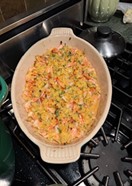
Before the tasting, we had dinner, so that the flavors of the food would not interfere with the flavors of the wine. (I had made Ina Garten’s baked shrimp scampi and served it over a bed of couscous. Don’t ask how much butter goes into that dish! Came out great.)
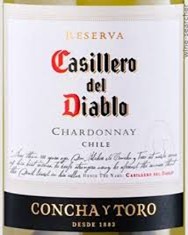
We tasted ten bottles of Chardonnay (covered in brown bags, so no one could see any of the labels). The tasting contained a several surprises, including a Chardonnay that turned out to be from Chile that tasted like a Burgundy: a 2022 Casillero del Diablo Reserva Chardonnay from Casablanca Valley, Chile. Yes, a $10 bottle of wine fooled all of us!
Before I tasted it blind, I would have walked right past this in the store, assuming it would be nondescript at best, and a butter bomb at worst. With aromas of green apple and flint, flavors of green apple and a touch of malolactic fermentation, giving it a rounder mouthfeel, most of us thought this was a classic Burgundy. Ridiculous at this price point! 13.5% ABV; $10 at Wineworks.
The second surprise of the night was that the $100 Burgundy from Puligny-Montrachet was so minerally that it wasn’t even in my top three! I thought it was a mid-level Chablis.
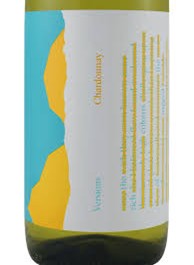
The wine I rated #2 in the blind tasting was a 2016 Handpicked Version Chardonnay from Yarra Valley, Victoria, Australia. (My guess was that this was from Northern Italy.) This wine has aromas of red apple, lemon, and copper penny, following by flavors of red apple, lemon, ginger, and a chalky finish on the palate, and higher acidity (making it food-friendly). Another surprising value at only $13 a bottle from Wine Library. 13% ABV.
My #3 wine was a 2022 Catena High Mountain Vines from Mendoza, Argentina. I had pegged this wine as being from Australia, with its tropical aromas of pineapple with a flinty finish, and flavors of pear and citrus, with a rounder mouthfeel on the palate. 13.5% ABV; $17 at Total Wine.
Another successful blind tasting, teaching me that I should not judge a wine by its label!


Leave a comment