In July, I was asked to do a Champagne tasting for one of my friends, who was hosting in Malvern, Pennsylvania. They supplied three of the five wines tasted, and I supplied two more to make up a variety of sweetness and varietals used in the blends.
They also wanted a “brief history of Champagne,” so I prepared one, which I will share with you here.
A Brief History of Champagne
Champagne is located about 100 miles east of Paris. Its proximity to Paris is both a blessing and a curse. A blessing, in that Paris, and its economy, were close by. A curse, in that invading armies would invade Champagne on their way to Paris.
Vineyards were first planted by the Romans in the 5th Century. However, the wines were a pale pink made from Pinot Noir. Due to the northern climate, the grapes would not ripen sufficiently. The early onset of cold weather would stop fermentation, which, if bottled before fermentation was completed, would re-start fermenting in the Spring. Bottles laid down the year and “reactivated” in the Spring could explode, or, if they didn’t explode, the wine would be bubbly, which the Champinois considered a fault.
Sorry to burst your (champagne) bubble, but while Dom Perignon (1638-1715) was a real benedictine monk who was in charge of the wine cellar at Abbaye Saint-Pierre d’Hautvillers, he did not invent Champagne. He never said, “Come quickly, I am tasting the stars!” That myth was first printed in a 19th Century advertisement for Champagne. During his lifetime, he worked to remove this “fault” of bubbles from the wine the Abbey made. He would probably be mortified to know what he was being celebrated for!
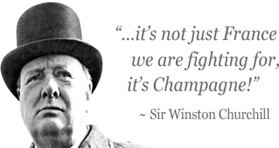
Luckily, neighbors to the North, the Brits, love a bit of bubbly, and started developing a taste for the faulted (bubbly, pale) wine in the 17th and 18th centuries, so Champagne vintners began making stronger bottles and controlling the “fault” better. In fact, a British doctor may have perfected the method.
There are 5 districts in Champagne where wine is produced: Arube, Cote des Blancs, Cote de Sezanne, Montagne de Reims, and Vallee de la Marne. Two cities, Reims and Epernay, are the commercial centers of the Champagne region. Only three grapes can be used to make Champagne: Chardonnay, Pinot Noir, and Pinot Meunier. Chardonnay is the dominant varietal in Cotes des Blancs and Cotes de Sezanne, Pinot Noir in Arube and Montagne de Reims, and Pinot Meunier in Vallee de la Marne.
Champagne can only be made in Champagne. Sparkling wine made anywhere else is not Champagne, although some wineries in California who are owned by French Champagne houses are allowed to put “Methode Champenoise” on their labels. Other producers worldwide may use “Methode Traditionelle” to indicate the second fermentation creating the bubbles occured in the bottle. Wines that use the Charmat Method to become bubbly by adding the tirage to still wine stored in large stainless steel tanks under pressure, such as Prosecco, cannot put “Methode Traditionelle ” on the label.
Unlike other regions in France, Champagne has “houses” rather than wineries. Champagne houses buy grapes from grower cooperatives to produce Champagne under their own brand name, such as Moët & Chandon and Veuve Clicquot. There is also “grower” Champagne, meaning that the grower also makes the Champagne. It used to be that you could distinguish between the two by looking for NM (Negociant-Manipulant = Champagne house) or RM (Récoltant-Manipulant = grower Champagne) on the label, but over the last decade, for marketing and other annoying Napoleonic law reasons, many RM’s don’t include RM on their labels anymore.
Champagne Production Basics
1) Ferment: Press grapes and ferment them (using either natural or cultured yeasts) until all of the sugar has been eaten by the yeast and converted into alcohol. This produces the base wine.
2) Tirage: Base wine is bottled with a mixture of yeast and sugar (“liqueur de tirage”) in order to start the second fermentation in the bottle, and capped with a crown cap.
3) Aging: The wines are left in the bottle for a minimum of 15 months.
4) Remuage: The wines are “riddled”, meaning the bottles are slowly turned (hand-rotated one eighth of the total rotation each day for 15 days) until they are upside down, and all of the dead yeast (“lees”) is in the neck.
5) Disgorgement: The bottles’ necks are dipped in liquid nitrogen and frozen, so that when the crown cap is removed, the frozen dead yeast (“lees”) pops out.
6) Dosage: Before corking the bottle, a mixture of sugar and alcohol, the “liqueur de dosage” is added to compensate for liquid lost during disgorgement. Liqueur de dosage consists of a mixture of sparkling wine, sparkling wine containing sucrose, grape must, brandy, SO2, or other components typical of a specific production area.
Scale of Dryness Used for Champagne:
Brut Nature 0-3 g/L residual sugar (RS)
Extra Brut 0-6 g/L RS
Brut 0-12 g/L RS
Extra Dry 12-17 g/L RS
Dry (aka Secco) 17-32 g/L RS
Demi-Sec 32-50 g/L RS
Doux 50+ g/L RS
Now that the history and science lessons are out of the way, on to the good stuff.

The Champagnes Tasted
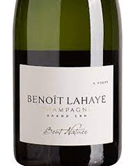
I supplied the first and driest of the Champagnes tasted: NV Benoit Lahaye Brut Nature (90% Pinot Noir 10% Chardonnay; sourced 80% from Bouzy and 20% from Ambonnay in Montagne de Reims) certified Organic; zero dosage. This was super dry, with no residual sugar. This is the current “trending” style of Champagne, and I have to admit I love it, but some in the group found it just too dry. $70 at Wineworks.
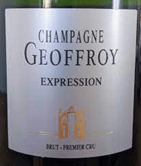
I also supplied the NV Geoffrey Expression 1er Cru Brut (Blend of all three Champagne grapes sourced from Cumieres and Hautvilliers in Vallee de la Marne; 50% of the year 2018 and 50% perpetual reserve started in 1970) 5.0 g/l RS, served third. I chose Champagne for three reasons: the higher amount of Pinot Meunier used in the blend, the perpetual reservere blend, and for being a Grower Champagne. Very tasty and a great buy for $50 at Total Wine.
The three other Champagnes supplied by one of the attendees were: a 2014 Delamotte Blanc de Blancs (100% Chardonnay sourced from all over Côte des Blancs) 6.5 g/l RS, served second, a 2012 Charles Heidsieck (60% Pinot 40% Chardonnay sourced from over 200 growers throughout Champagne; house located in Reims) 8.0 g/l RS, served fourth; and a NV Billecart-Salmon Brut Rose (40% Chardonnay from throughout Champagne, 30% Pinot Noir from Montagne de Reims and Vallee de la Marne, 30% Pinot Meunier from Vallee de la Marne and Epernay) 9.0 g/l RS, served last.
I hope you enjoyed this class on Champagne!
Salut!
 VinoBrief
Leave a comment