As I mentioned last month, in March, I was invited to the 45th annual Dionysian Gathering for the North American Branch at the Flanders Hotel in Ocean City, NJ. The Dionysian Society is the world’s oldest wine society, dating back to ancient Greece. The weekend included four wine seminars, two formal dinners paired with wines, and a sparkling wine brunch.
The second afternoon, we had two seminars: one on the five S’s of wine tasting (see, swirl, smell, sip, and spit/swallow), and one on sparkling wines from England. This column will cover sparkling wines from Chapel Down Winery in Kent, England.
When the Romans invaded the British Isles in 43 A.D., they brought vines with them.* However, Roman trading routes with France and Italy provided most of the wine to the Romans in Britain. For the next 1000 years, viticulture waned when the Vikings were invading (and drinking beer and mead), and waxed when Christianity (which used wine in communion) was spreading again. The Domesday Book, written in the 11th Century after the Norman invasion, records 42 vineyards in England, a dozen of which belonged to monasteries. The arrival of the bubonic plague depleted farm labor, and farmers turned to less labor-intensive crops, which grew more quickly and yielded more product than vineyards.
Several hundred more years of trading with, fighting with, and marrying the French provided a steady stream of wines from France, which flavor profile the British nobility preferred. Rather than focusing on growing, the Brits focused on trade (selecting, importing, and bottling the best wines from Europe). World War I brought the struggling British winemaking industry to a full stop, as arable land was needed for food crops.
The first commercial vineyard, making Seyval Blanc wine for sale, was planted in 1952 in Hambledon, Hampshire by Major-General Sir Guy Salisbury-Jones. The industry continued to grow (slowly), with new agricultural methods developed by George Ordish (author of “Growing Wine in England,” published 1953) and the discernment of the best varietals to grow in England by Ray Barrington Brock (founder of the Oxted Research Station in Surrey).
With climate change, the climate in Southern England in the 21st Century is similar to the climate the Champagne region used to have in the 20th Century. The traditional Champagne grapes of Chardonnay, Pinot Noir, and Pinot Meunier are being planted in England. As of 2022, there are nearly 200 wineries in the United Kingdom, English sparkling wine is winning blind-tasting awards around the world, and no doubt poured at the King’s coronation.
We were joined by Brenton Blanchard of Chapel Down, the largest winery in the UK. He provided four sparkling wines for us to taste. Brent used to work for Moët & Chandon, but has “seen the light” (his words, not mine – mine would have been “read the writing on the wall”) and moved across the Channel.
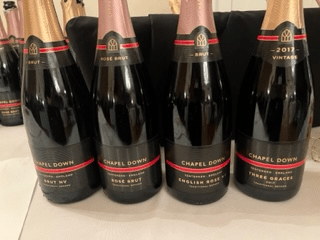
The first wine was simply called “Brut”, made from 52% Chardonnay, 35% Pinot Noir, 7% Pinot Meunier, 5% Pinot Blanc, and 1% Early Pinot Noir.+ The fruit is sourced from vineyards in Kent, Essex, and East Sussex. The grapes are fermented in stainless steel tanks, followed by full malolactic fermentation, and matured on the lees. The wine is bottled for another 18 months before release. The flavor profile was very similar to a Champagne: yeasty apple on the nose, apple, citrus, and baking spices on the palate, with a creamy mouthfeel. I rated this 17/20. 12% ABV. Available for $45 on wine.com, or $49 on special order from Traino’s.
The second wine, my favorite, was called “English Rose,” a nice play on words. This sparkling Rosé was made from 51% Chardonnay, 34% Pinot Noir, 7% Pinot Meunier, 5% Pinot Blanc, and 3% Early Pinot Noir. The grapes are fermented in stainless steel tanks, followed by full malolactic fermentation, and matured for six months on the lees. The wine is bottled, and aged for another 18 months on the lees in bottle before release. On the nose, lemon, strawberry, and red apple notes, which continued on the palate, joined by red currants. This pretty, light pink wine was very nicely balanced. I rated this 18/20. 12% ABV. Available for $46 on wine.com, or $55 on special order from Traino’s.
The third wine was “Rosé Brut NV,” made from 77% Pinot Noir, 19% Early Pinot Noir, and 4% Pinot Meunier. The grapes are sourced from vineyards in Kent. Fermentation occurred in stainless steel tanks, with full malolactic fermentation, and matured for six months on the lees before being bottled and aged another 18 months on the lees in bottle. On the nose and palate, strawberries, bright cherry, red currants, and toasted bread. Fine mousse. I rated this 18/20. 11.5% ABV. Available for $67 on wine.com, or $71 on special order from Traino’s.
The fourth wine was a 2016 “Three Graces,” made from 60% Chardonnay, 36% Pinot Noir, and 4% Pinot Meunier. The grapes were sourced from vineyards in Kent. Fermented in stainless steel tanks, and matured on the lees in tank for six months before being bottled, with a minimum three years further aging on the lees in bottle before release. Some reserve from other vintages aged in barrel is added for depth. On the nose, pear, red berries, oak, and toasted brioche aromas, continuing on the palate, with a full, creamy mouthfeel. Long finish, with lots of fruit. This needed a bit more time in bottle; it was still a little tight/closed to me. For that reason, I rated it 16/20. 11.5% ABV. Available for $69 on wine.com and a bargain at $65 on special order at Traino’s. The next time I’m in the UK, a visit to a winery will be included in the itinerary. Cheers!
*Information taken from “A Brief History of English Wine” article on the Lyme Bay Winery website.
+Early Pinot Noir is known as Pinot Noir Précoce in France and Frühburgunder in Germany. It is a mutation of Pinot Noir that ripens earlier, hence the name “Early Pinot Noir.”
 VinoBrief
Leave a comment