I hope that you and yours are all healthy and bearing up sufficiently under self-isolation. Although I’m saving money from not eating out, my newly-acquired habit of a 5:00 pm Bombay Sapphire gin and tonic is not cheap! I’ve also started purchasing wines by the case, since I want to limit my shopping exposure. Thus, I’ve been searching for wines that deliver a lot of quality for the price, so that I don’t flinch when I see the case price. Here are a couple of my recent discoveries.
It’s difficult to find an inexpensive bottle of wine from Alsalce. Control of this Northeastern region of France, bordering Germany and Switzerland, has switched between France and Germany many times over the centuries. Since the Treaty of Versailles ending WWI, it has been part of France, but culturally, it is a charming mix of French and German. The Alsatian dialect is closer to German than French, and an officially recognized regional dialect of France. The timbered houses could be from a village along the Rhine. The cost of land and labor is high here, leading to more expensive wines.
The wine region lies just west of Strasbourg, the region’s capital, and begins at about the same longitude. The wine country then travels south, between the foothills of the Vosges Mountains to the West and the Rhine River to the East. The wine varietals grown here are also strongly influenced by Germany, with Riesling and Gewurztraminer commonly grown, in addition to the French varietals of Pinot Blanc and Pinot Gris.
Unusually for France, Alsatian wines labels indicate the varietal on the label, rather than the village or region of origin, because the wines were historically shipped via the Rhine with German wines. Also unusual is that the wine inside the bottle must be 100% the varietal named on the label. Blends are labeled “Gentil” or “Edlzwicker.” Alsatian wine is bottled in tall flûtes d’Alsalce, also known as Rhine wine bottles, which Germany uses for its white wines.
Alsatian wines are known to be dry and aromatic, with predominant peach and floral notes, and made to be paired with food. The wines are not aged in oak casks, relying upon higher alcohol content (14-15%) for body instead. Well-known producers include Maison Trimbach, Domaine Zind-Humbrecht, and Hugel & Fils.
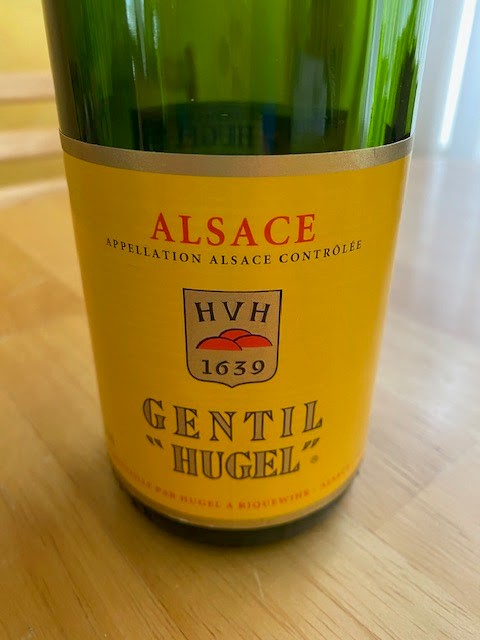
The inexpensive bottle of Alsatian wine I’ve been drinking while isolating is Hugel & Fils 2018 “Gentil.” This white is a blend of Gewurztraminer, Pinot Gris, Riesling, Muscat, and Sylvaner. The wine is medium-bodied, and very dry. Aromas of green apples and lemons continue on the palate, with a tangy finish. It pairs wells with fresh and roasted vegetables, chicken and fish. This has definitely earned a spot in my usual rotation. Wineworks carries it for $12 a bottle, Traino’s carries it for $14. James Suckling rated it 90 points.
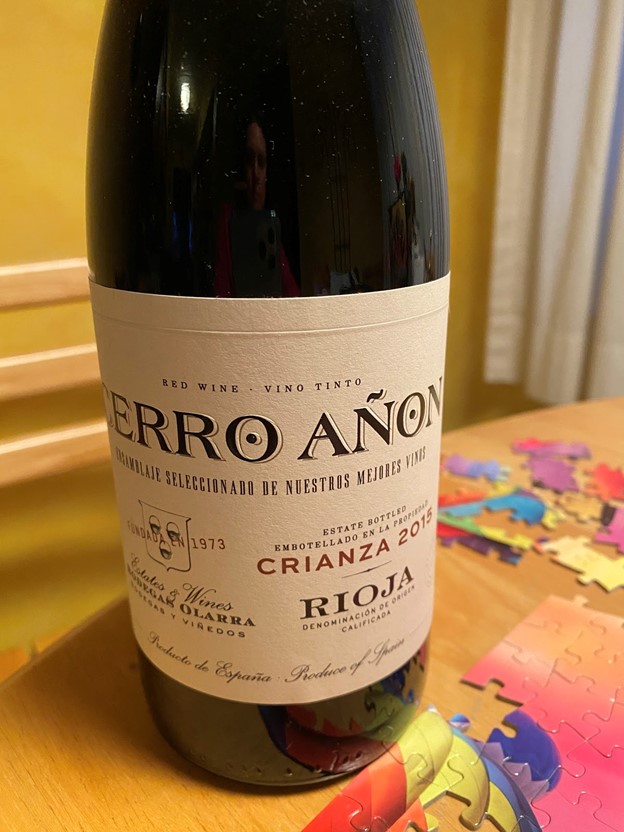
I tried several bottles of Rioja, trying to find an acceptable one under $15. (I’ve written about Rioja before, so I won’t give you a lesson on the region here.)
First, I tried Cune’s 2016 Rioja Crianza ($12), which was good, but not in the traditional style of Rioja I was looking for. Next, I tried Bodegas Abanico Hazana’s 2015 Rioja Vinas Viejas ($12), which had a little too much jammy/cherry cola flavor on the finish for me.
Finally, I tried Bodega Olarra’s 2015 Rioja Cerro Anon Crianza ($12), a blend of tempranillo, graciano, and mazuelo. A strong note of vanilla greets you when you raise the glass, from the American oak it’s fermented in. Dark fruit, tea leaf, and some gamey notes on the palate. It’s a little closed, but improves with aeration. Medium-bodied with silky tannins. While not the traditional complex cherry and leather notes I prefer, this was definitely a bottle of wine that I would think costs twice as much as it does. If it’s sold out, the next level up is their Reserva, for only $18 a bottle. Also a steal.
I hope that the next time I’m writing a wine column, we will have a release date. Until then, stay safe and sane. Cheers!
 VinoBrief
Leave a comment