The lengths I go to, dear readers, in order to discover new delights for you! This August, I went so far as the Basque region in Northeast Spain/Southwest France, and it was delightful.
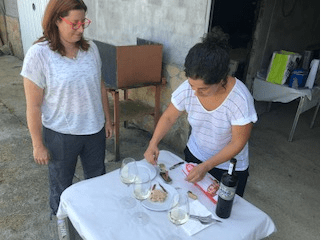
We flew into Bilboa on a Sunday, rented a car, and headed straight for Getaria, a fishing village about a half hour west of San Sebastian. There, we met winemaker Maitena Barrero of Bodega Adur. We followed her SUV up winding roads, past the village limits of Geteria, and high into the vineyards of the region of Getariako Txakolina.
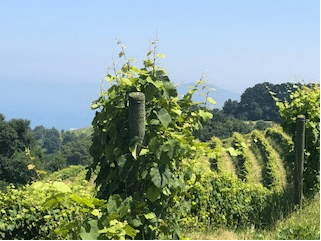
Txakoli is a high acid, low alcohol, slightly sparkling wine that pairs exceptionally well with the bountiful seafood harvested from the Bay of Biscay. Maitena set up a table in her vineyards, complete with anchovies and bonita tuna, and spoke while slicing up a baguette. After working in wineries in Northern and Southern hemispheres, Maitena and her husband, Hector Gomez, returned to San Sebastian, and began applying everything they had learned to their one-acre vineyard of Hondarrabi Zuri, the main coastal varietal used in Basque.
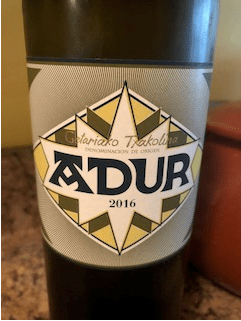
The result is a modern take on Txakoli: gone is the fizz, and in its place is lemon with a slight salinity courtesy of the ocean breezes. The acid is still high (which, as you should know by now, makes it pair well with food), and the alcohol is slightly higher than traditional Txakoli, clocking in at 11.5%.
On Thursday, we drank another bottle of Bodega Adur with a tableside-filleted turbot on the patio at Kaia, watching fishing boats bob in the marina. (And for those wondering, yes, we also ate turbot at Elkano, but since it was my turn to drive, I didn’t drink at that dinner.)
Just prior to our lunch at Kaia, we visited Txomin Etxaniz, a winery in existence since at least 1649. They own 35 hectares of hillside vineyards in Getariako Txakolina, producing Hondarrabi Zuri (90%), the white grape, and Hondarrabi Beltza (10%), the black (red) grape used in Txakoli.
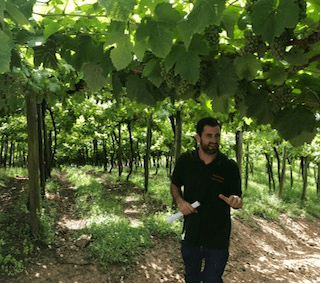
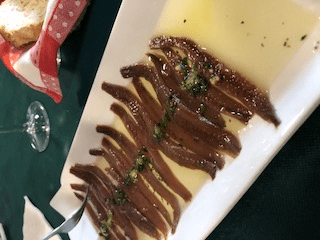
Mikel Txueka, one of the many family members working for the winery, gave us a tour of the vineyards and the winemaking facility before we tucked into more delicious anchovies and bonita tuna (both filleted by his mother) for the white and rosé tasting. Here, they produce Txakoli in the traditional method: their vines are trellised above our heads, a ceiling of green. The wine is poured from about a foot above the glass to release the fizz. Yellow-green in color, with a lemony aroma, slightly acidic and fizzy on the tongue. At the winery, you can also buy a late harvest, off-dry Txakoli named after their grandfather, Uydi, and a sparkling Txakoli named after their grandmother, Eugenia.
I’ve written about Txakoli before, as it is a wonderful summer quencher. The white and rosé Txomin Etxaniz are readily available in larger wine stores for about $20. Topa!
 VinoBrief
Leave a comment