At the end of September, I had the pleasure of spending a week in the Azores, with my friend and Bar Association colleague, Elizabeth Garcia, and two other friends. The Azores had been on my bucket list since my 1990s obsession with the Lucas Arts game “Indian Jones and the Fate of Atlantis,” my favorite procrastination diversion during law school. The Azores was one of the possible locations of Atlantis in the game. While I did not find any evidence of Atlantis on our visit to five of the nine islands, I did find evidence of a much more civilized society, where I was not bombarded with news 24/7, I had no wifi and often no cell signal, food and wine are cheap, and I was never far from a moss wall, volcano, or sweeping vista of the Atlantic Ocean.
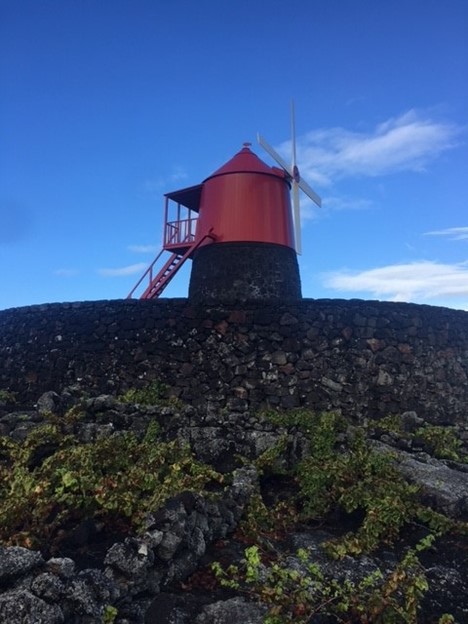
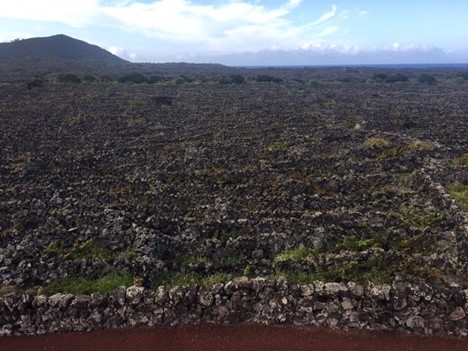
We ate plenty of cod and sausage, and devoured cheese and bread at every meal. We visited churches; hiked up volcanos and down into calderas. We also drank a lot of wine. Liz’s family is from the Island of Pico, located in the central grouping of islands in the archipelago, comprised of nine islands altogether. At only 270,000 years old, Pico is the youngest island in the Azores, and contains Ponte de Pico at its center, a slumbering volcano which is the highest peak in Portugal. Pico is famous for its black volcanic soil, and its unique vineyards where the vines are not trellised, but lay on the ground in basalt rock pens called “currais” fitted together in a giant maze, to protect the grapes from the ever-present wind. The vineyards are so unique, that they were designated a UNESCO world heritage site in 2004. The wineries do not have their own tasting rooms; rather, there are cooperatives in the larger towns where one can taste the Pico wines.
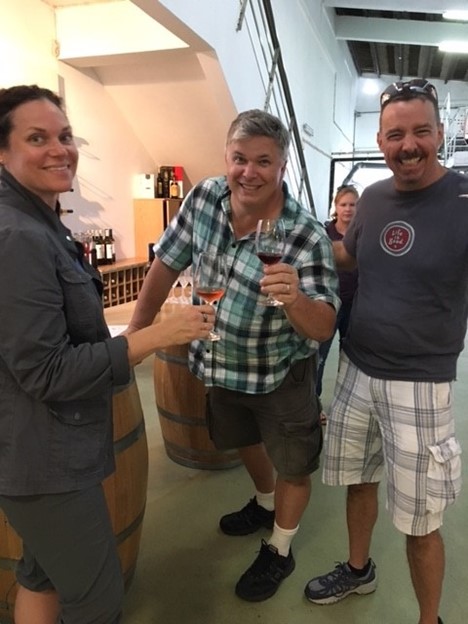
Pico is well-known for its Lajida, a type of off-dry aperitif that reminded me of Amontillado sherry. Lajida is also the name of a village on Pico, and also the name of smooth lava rock on Pico. While Pico’s white wine industry is well-developed, its red wine production is in its infancy. I brought home one bottle of each, a white and a red.
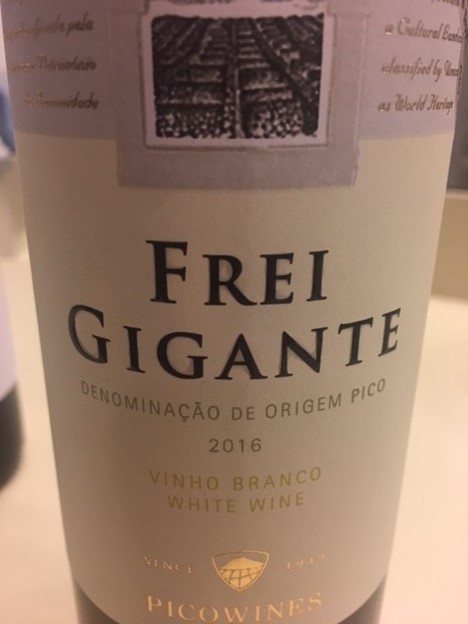
The white wine packed is a 2016 Frei Gigante, an award-winning blend of Arinto, Verdelho, and Terrantez (a local Azorean grape). The wine is golden in color, with honey, lemon, and tropical fruit notes, and a clean, dry finish with solid acidity, making it a perfect food match. The wine is barrel-fermented for a period, but not noticeably oaky. This was my favorite white wine from Pico, and came in under 10€ at bottle.
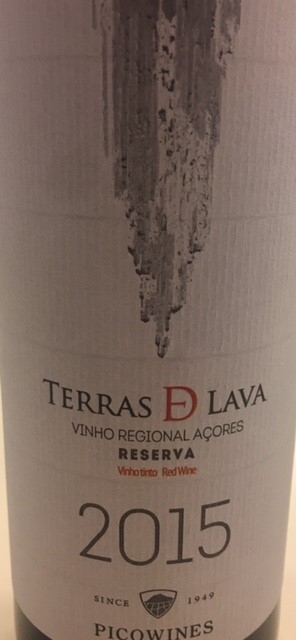
The red wine I brought back is a 2015 Terras D Lava Reserve, a red blend containing Cabernet Sauvignon and Merlot, which had the usual Cabernet Sauvignon and vanilla notes. It was a pleasant, modern-style wine which could have come from anywhere. The local wine style of their red wine (“Tinto”) is much higher in acid and slightly effervescent.
Sadly, an online search did not yield any Azorean bottles available to buy in the USA, yet. Pico is really ramping up their wine production, so I hope to see some imported to the USA in the near future. Suade!
 VinoBrief
Leave a comment